The triangle in the palm: the sign of what you have understood

Three small strokes closing a figure: a triangle. The tradition reads in it an understanding gained — something you learnt and will not forget again. Like every rare sign, it is read by the place where it sits.
How to recognise a triangle
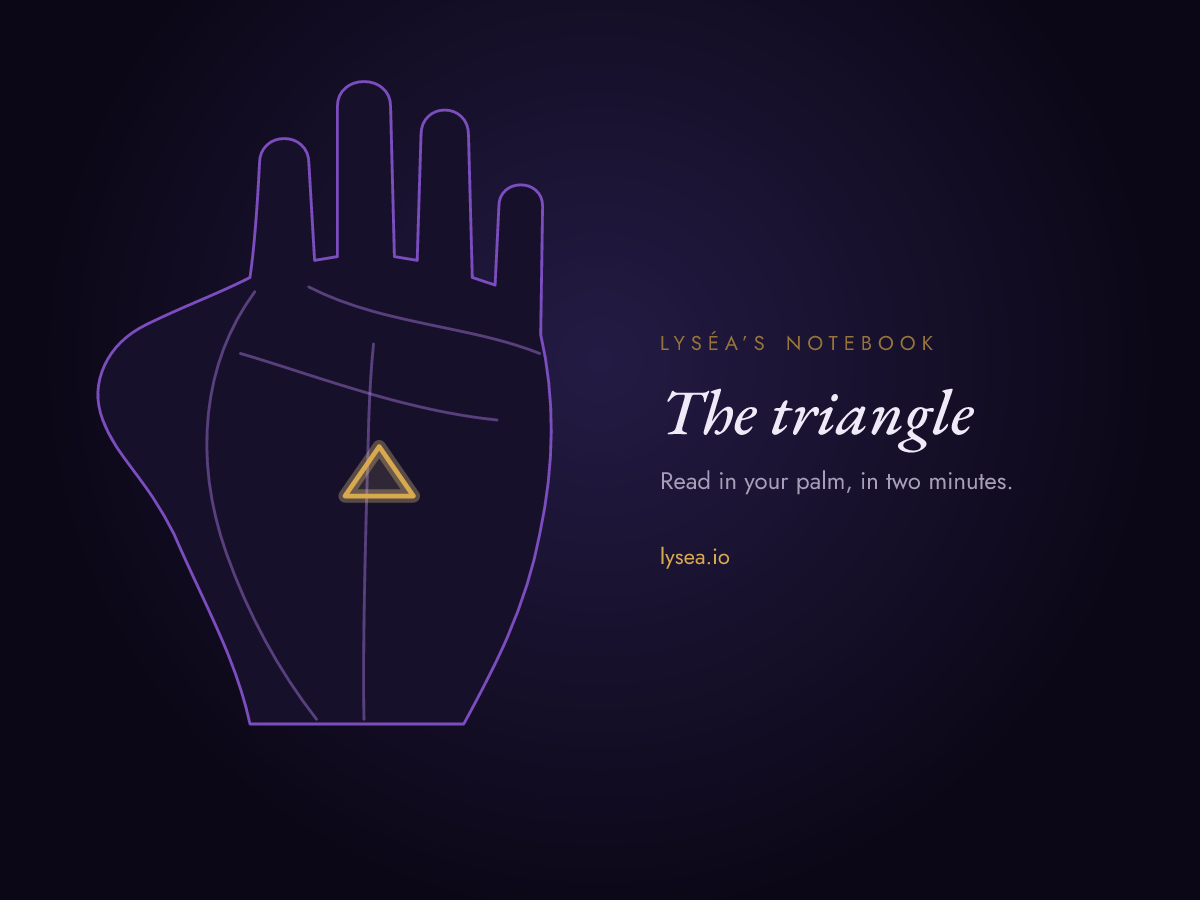
A triangle is a closed figure: three short strokes meeting at the corners. On the diagram, it is drawn in gold, in the centre of the palm below the head line. All three sides have to be drawn and the figure has to be closed, or nearly: an open corner makes a chevron, not a triangle. It also differs from the large triangles the major lines draw between themselves — the tradition names those too, but they are other readings.
The small isolated triangle is rare: Lyséa records one on roughly one hand in ten, often tiny, often in the centre of the palm or on a mount. The triangles you get by joining three creases are not triangles; a real one has all three sides drawn.
What the tradition reads in it
The triangle is read as an understanding: something the person grasped, often through experience, which became a way of seeing. Where the star speaks of an event, the triangle speaks of what you drew from it. It is the sign of people who learn from what happens to them, and who do not make the same mistake twice.
It is also read as a reserve — a capacity kept within, used little, but there when it is needed. The people who carry a clear triangle are often those who are underestimated until the day they show what they know.
In the centre of the palm: the triangle of the plain of Mars
It is the most frequent place. In the hollow of the hand, between the head line and the life line, the triangle is read as a strength learnt through hardship: the person went through something difficult and kept from it a way of holding on. The tradition sees in it a calm that does not come from temperament but from experience — you have already been afraid, you know how it goes.
Lyséa reads it with the head line above it: a triangle below a straight head line speaks of a practical understanding; below a sloping one, of a more inward understanding, which you cannot always explain.
On the mounts: index, middle, ring and little fingers
On the mount of Jupiter, below the index finger, the triangle speaks of an authority learnt: someone who understood how to lead without crushing, often after doing it badly a first time. On the mount of Saturn, below the middle finger, it speaks of an understanding of what lasts — time, patience, what is built slowly. The tradition sees in it the hands of builders and researchers.
On the mount of Apollo, below the ring finger, the triangle speaks of a craft — a talent turned into a trade, a way of creating you learnt to hold. On the mount of Mercury, below the little finger, it speaks of speech and exchange: quickly understanding what the other means, and knowing what to answer.
On the mount of Venus, at the base of the thumb, the triangle is read as an attachment understood: someone who knows what loving costs them and gives them, and who loves with that knowledge. On the mount of the Moon, on the opposite edge, it speaks of an imagination held in check — one that serves instead of leading astray.
On a line: life, head, heart
A triangle sitting on the life line speaks of a lesson drawn from a turning point, at the place where it sits on the arc. On the head line, it speaks of a method: the person found their way of thinking, and sticks to it. On the heart line, it speaks of an attachment you understood something from — often after it ended, and which changed the way you loved afterwards.
A triangle formed by a major line and two branches leaving it is read differently: the tradition sees in it a moment when you held two things together before choosing. Lyséa tells the two apart, and says so.
How Lyséa reads it on your photo
On the image of your palm, Lyséa records the closed, isolated triangles and their exact place. An open or doubtful triangle is recorded as absent. Then, if it is there, she writes it with the mount or the line that carries it, and with what she recognises of what you have learnt — in the present tense, without making it say more than it does.
The rare signs are one of the twelve pages of your notebook. The photo is analysed, then deleted. Two minutes, no account, no card.
All of this is written in your palm — it still has to be read.
Scan my palm — free2 minutes. 3 free revelations, no card required.
The questions people ask Lyséa
- Is a triangle in the palm rare?
- Yes: Lyséa records a clear one on roughly one hand in ten, often small, in the centre of the palm or on a mount. The triangles you get by joining three creases are not triangles.
- What is the difference between a triangle and a star?
- The star is made of strokes crossing at one point; the triangle is a closed figure, three sides, three corners. The tradition reads the star as an event and the triangle as what you understood from it.
- What does a triangle in the centre of the palm mean?
- In the hollow of the hand, below the head line, the tradition reads in it a strength learnt through hardship: a calm that comes from experience, not from temperament. It is the most frequent place for the triangle.
- Does the large triangle formed by my major lines count?
- That is another reading. The large triangle the life, head and fate lines draw between themselves is named by the tradition, but it is not the small isolated sign this page is about. Lyséa tells the two apart.
Read next
Updated on 2 September 2026. Palmistry is a tradition, and is cited as one. Entertainment service.