The cross in the palm: what it marks, depending on where it is

Two short strokes crossing, set apart from the rest: a cross. The tradition reads in it a point of tension — a place in life where two forces met. And as with every rare sign, it is its position that says which ones.
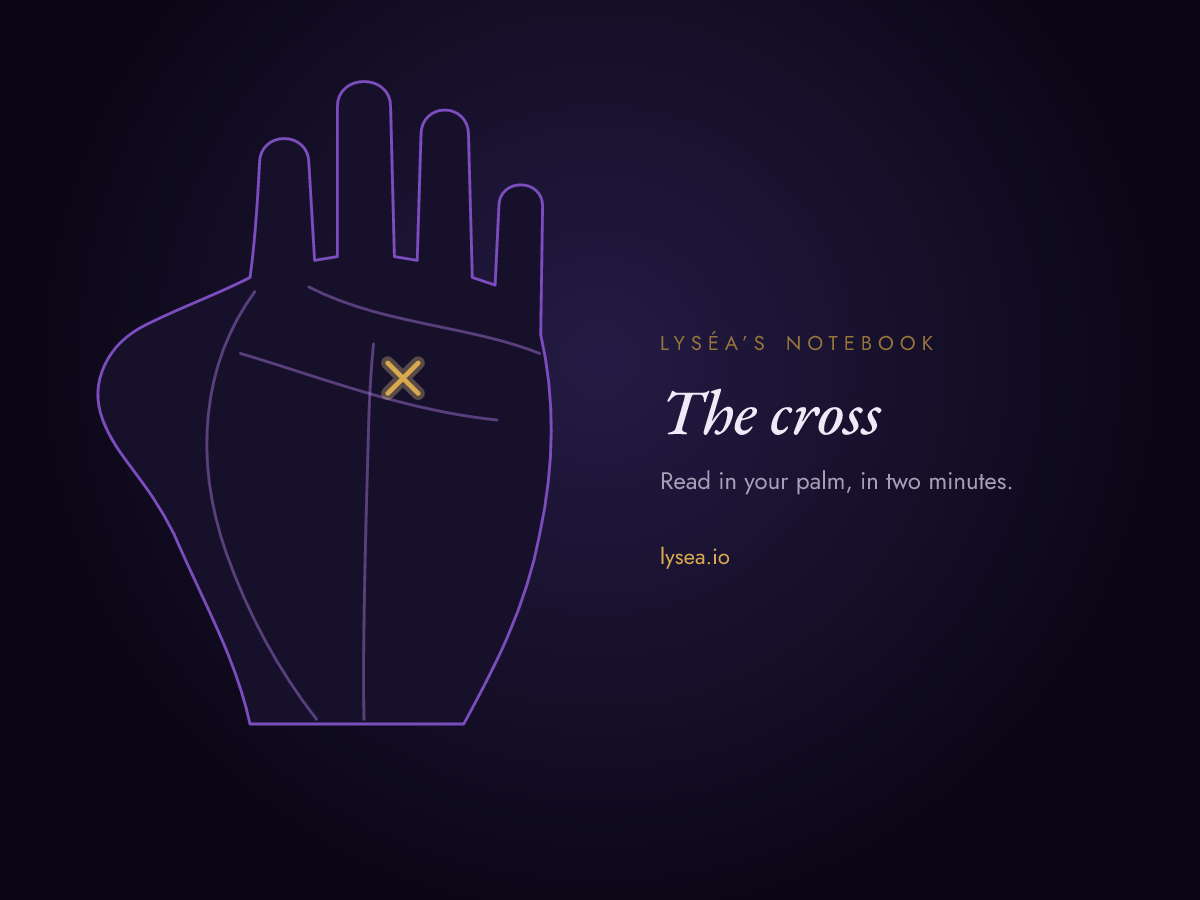
How to recognise a cross
A cross is a small, self-contained drawing: two short strokes, roughly the same length, crossing at their middle. On the diagram, it is drawn in gold, between the heart line and the head line. It differs from the natural crossing of the major lines — the fate line cuts across the head line on almost every hand, and that does not make a cross — by its size and its isolation: a cross that counts as a sign is short, clear, and extends no line.
Lyséa records it when both strokes are visible without looking hard. A cross formed by two creases brushing past each other is not one.
What the tradition reads in it
The cross is read as a meeting of forces: a place where two things stood against each other — a desire and an obligation, one person and another, what you wanted and what you had to do. It does not say who won. It marks that the tension took place, and that it left a trace.
That is why the old tradition often gave it a dark meaning. Lyséa does not follow it: a cross speaks of a point of friction, and points of friction are where you learnt the most. She reads it as a mark of passage, never as a threat.
Between the heart line and the head line: the mystic cross
It is the most discussed cross. Sitting in the space between the two major horizontal lines, in the centre of the palm, the tradition calls it the mystic cross and credits it to minds drawn to the unseen — intuition, symbols, questions without proof, what cannot be shown and is felt all the same. Lyséa reads in it a way of understanding that goes through something other than reasoning, and that is often right.
It is more frequent than the other crosses: Lyséa records one on roughly one hand in five. It is read with the space that carries it: between a heart line and a head line set very close together, the mystic cross says that intuition and feeling mingle; between two lines set far apart, that it is kept aside, like a reserve you say little about.
On the mounts: index, middle, ring, little finger, thumb
On the mount of Jupiter, below the index finger, the cross is read as a meeting that counted for the place you took: someone, or an opportunity, that opened a door. The tradition holds it to be one of the most favourable. On the mount of Saturn, below the middle finger, it speaks of a tension with what lasts — a long obligation, a setting endured, something you carried without having chosen it.
On the mount of Apollo, below the ring finger, the cross speaks of a friction around what you show: a thwarted talent, a disputed recognition. On the mount of Mercury, below the little finger, it speaks of a tension in speech and exchange — words that wounded, or that were held back too long.
On the mount of Venus, at the base of the thumb, the cross is read as an attachment that was a point of tension — a love that ran up against something else. Lyséa reads it with the life line that surrounds it, and makes it say only what the person recognises.
On a line: life, head, heart, fate
A cross sitting on the life line marks a thwarted turning point: a change that did not happen without resistance, at the place where the cross sits on the arc. On the head line, it speaks of a decision taken against yourself, or against your own people. On the heart line, of an attachment that met an obstacle — and the tradition does not say whether it held.
On the fate line, the cross is read as an obstacle on the road: a direction thwarted by circumstances or by someone. What is read is what the line does afterwards: if it goes on clear, the person got through; if it breaks, they changed route.
How Lyséa reads it on your photo
On the image of your palm, Lyséa records the clear, isolated crosses and their exact place — between the lines, on a mount, on a line. A crossing of creases is recorded as nothing. Then, if a cross is there, she writes it with the place that carries it and with what she recognises of the tension it speaks of — in the present tense, as a mark of passage, never as a threat.
The rare signs are one of the twelve pages of your notebook. The photo is analysed, then deleted. Two minutes, no account, no card.
All of this is written in your palm — it still has to be read.
Scan my palm — free2 minutes. 3 free revelations, no card required.
The questions people ask Lyséa
- Is a cross in the palm a bad sign?
- No. The old tradition gave it a dark meaning, which Lyséa does not follow: a cross marks a past point of tension, a place where two forces met — and that is where you learn the most.
- What is the mystic cross?
- A cross sitting between the heart line and the head line, in the centre of the palm. The tradition credits it to minds drawn to the unseen — intuition, symbols, questions without proof. Lyséa records one on roughly one hand in five.
- Are a cross and a crossing of lines the same thing?
- No: your major lines cross naturally, that is the geometry of every palm. The cross that counts as a sign is a small, self-contained drawing, short and clear, which extends no line.
- What does a cross below the index finger mean?
- On the mount of Jupiter, the tradition reads in it a meeting that counted for the place you took — someone or an opportunity that opened a door. It is one of the crosses it holds to be most favourable.
Read next
Updated on 2 September 2026. Palmistry is a tradition, and is cited as one. Entertainment service.