The star in the palm: what it says, depending on where it is

Three strokes or more crossing at a single point: that is a star. It is never read on its own — it is its place in the palm that says what it is worth. Lyséa always begins there.
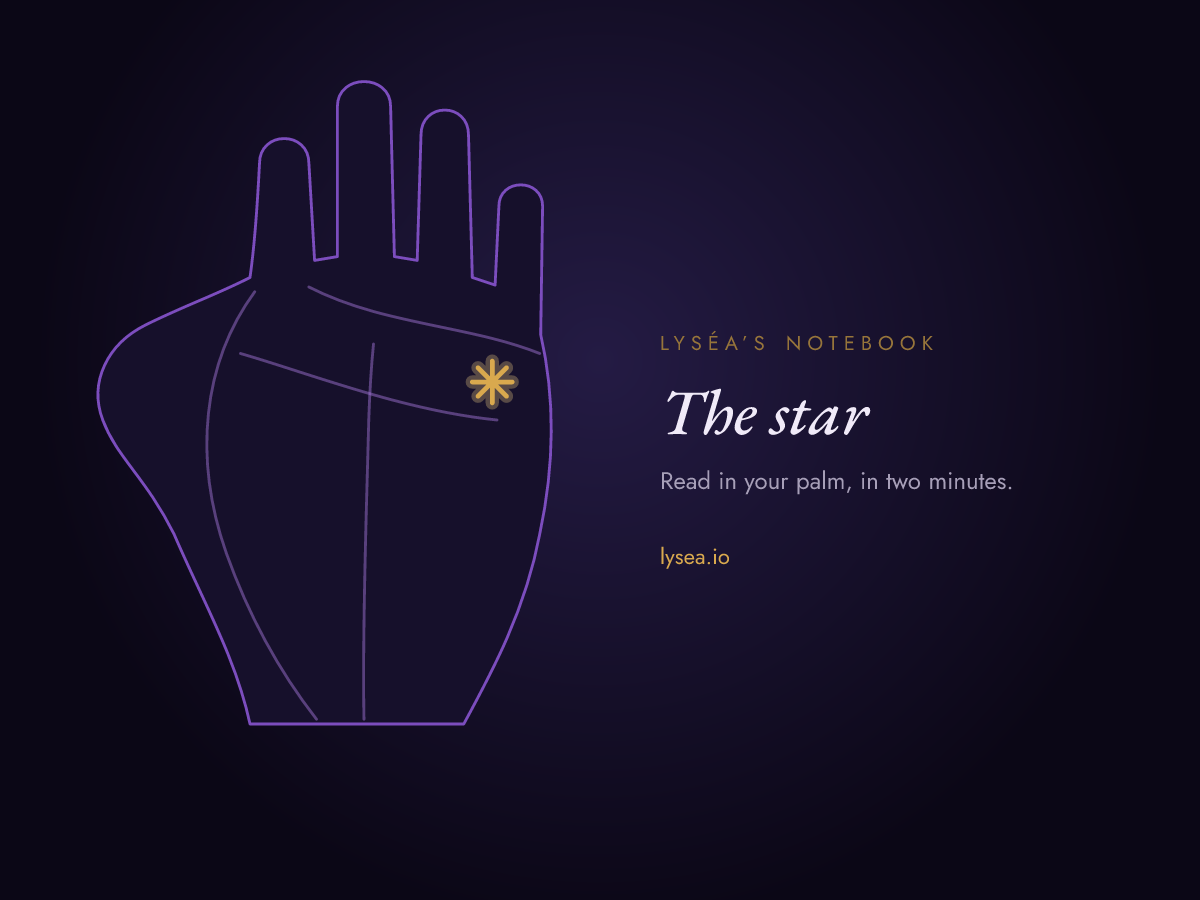
How to recognise a star
A star is a small, self-contained drawing: at least three short strokes crossing at the same point, like rays. On the diagram, it is drawn in gold, below the ring finger. It differs from a simple crossing of two lines — which only makes a cross — and from the web of creases that covers some palms. A real star is clear, isolated, and its branches leave from the same centre.
It is a rare sign in the strict sense: out of a hundred hands, Lyséa records about ten, and most of them are small. The stars you find by looking hard are often crossings of creases; the ones that count are seen without looking.
Below the ring finger: the star of Apollo
It is the most discussed one. Sitting on the mount of Apollo, at the base of the ring finger, or at the tip of the Sun line, the tradition reads in it a recognition that goes beyond what the person expected: a talent seen, a piece of work noticed beyond the circle it was meant for. It does not mean fame; it means that what you show is received, and sometimes carried further than you sent it.
Lyséa reads it with the Sun line: a star at the end of a clear line confirms what the line says; a star on its own, without a line, speaks of a recognition that arrived without being built — and the tradition finds that one more fragile.
Below the index, middle and little fingers
On the mount of Jupiter, at the base of the index finger, the star is read as an ambition that finds its place: the person takes an authority that others grant them, often late, often after giving it up once. It is one of the stars the tradition holds to be most favourable.
On the mount of Saturn, below the middle finger, the star is read with more gravity: the tradition sees in it a weight carried alone, a responsibility that was not chosen. Lyséa reads it as a way of holding — these people hold on when others let go — and refuses to read anything else into it.
On the mount of Mercury, below the little finger, the star speaks of speech: someone whose words carry, who is listened to, who convinces. The tradition also sees in it a quickness of understanding, and a risk of using it badly.
On the lines: life, head, heart
A star sitting on a line is read with the line. On the life line, the tradition sees in it an event that changed everything, at the place where the star sits: high on the arc, a turning point of youth; lower down, later. A position, never a date. On the head line, a star speaks of an idea, a discovery, a way of thinking that tipped over all at once.
On the heart line, the star is read as an attachment that marked you beyond the others — often the one you did not look for. The tradition also sees in it an intensity that cost something. Lyséa reads it from what the person recognises, never from the sign alone.
In the centre of the palm and on the mount of Venus
In the centre, in the hollow of the hand the tradition calls the plain of Mars, the star speaks of a strength gained through hardship: someone who went through something hard and came out steadier. On the mount of Venus, at the base of the thumb, it speaks of an attachment — family, love, friendship — that took up all the room at one moment of life.
On the mount of the Moon, on the opposite edge of the palm, the star is read as an imagination that led somewhere — a journey, a creation, an elsewhere that became real. The tradition also sees in it the risk of getting lost there.
How Lyséa reads it on your photo
On the image of your palm, Lyséa records the clear rare signs — star, cross, triangle, island, grid, letter M — and their exact place. A doubtful star is recorded as absent: she would rather say nothing than make a crease say what it does not. Then, if the star is there, she writes it with the place where it sits, and with the line or the mount that carries it.
The rare signs are one of the twelve pages of your notebook. The photo is analysed, then deleted. Two minutes, no account, no card.
All of this is written in your palm — it still has to be read.
Scan my palm — free2 minutes. 3 free revelations, no card required.
The questions people ask Lyséa
- Is a star in the palm rare?
- Yes, in the strict sense: out of a hundred hands, Lyséa records about ten, often small. The stars you find by looking hard are generally crossings of creases; the ones that count are seen without looking.
- What does a star below the ring finger mean?
- It is the star of Apollo: the tradition reads in it a recognition that goes beyond what you expected — a talent seen, a piece of work noticed further than planned. It is read with the Sun line.
- Is a star on the life line a bad sign?
- No. The tradition sees in it an event that changed everything, at the position where the star sits on the arc. Lyséa reads no sign as a threat: a star speaks of a turning point, not of a misfortune.
- How do I tell a star from a simple crossing of lines?
- A star has at least three strokes leaving from the same centre, like rays, and it is isolated. Two lines crossing make a cross; a web of creases makes nothing at all.
Read next
Updated on 2 September 2026. Palmistry is a tradition, and is cited as one. Entertainment service.