The head line: how you decide, read in your palm

The head line crosses the middle of the palm. It does not measure intelligence — the tradition never claimed it did. It says how you think, and above all how you make up your mind.
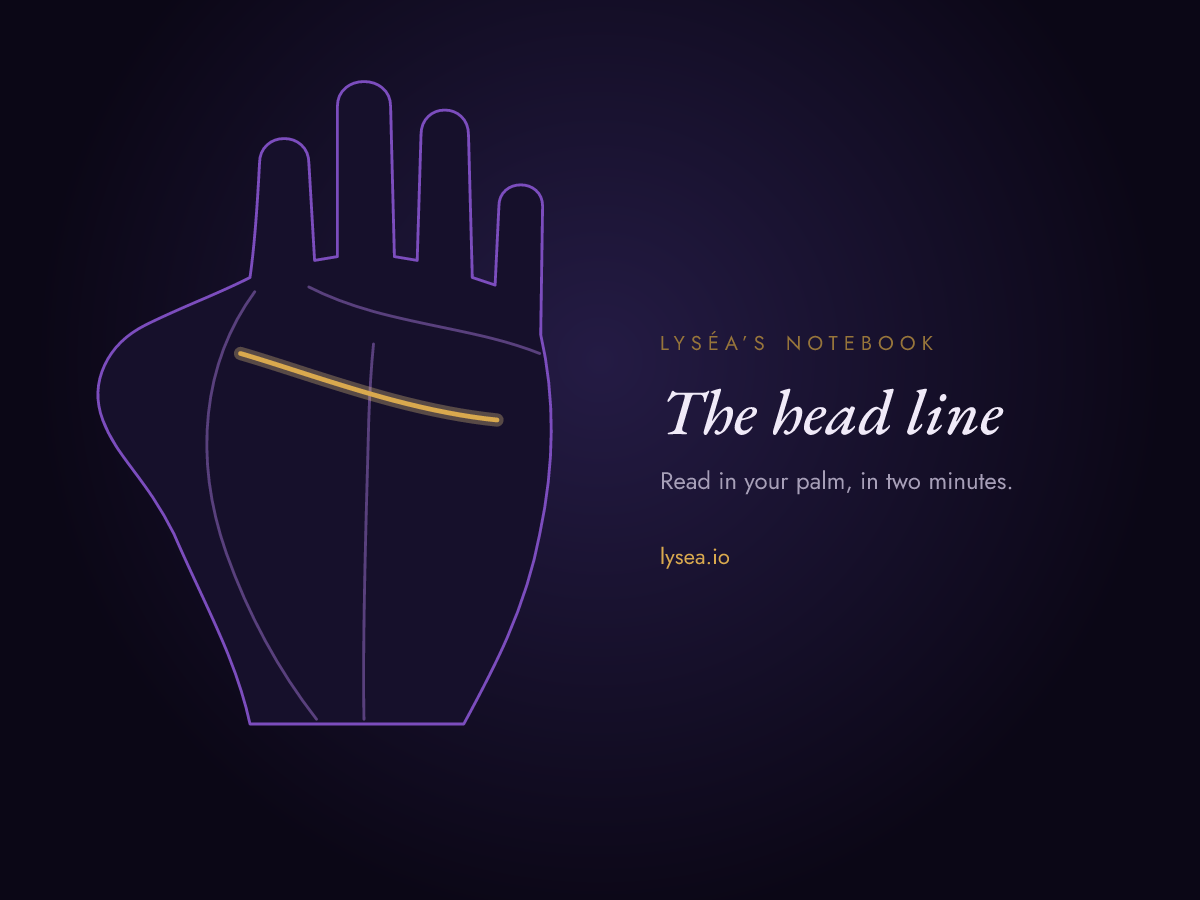
Where the head line is
It starts at the edge of the palm, between the thumb and the index finger, often at the same point as the life line, and crosses the hand towards the opposite edge. On the diagram, it is the golden line in the middle. Above it runs the heart line; below it, the arc of the life line. Its length, its slope and its starting point are the three things Lyséa records first.
In roughly one person in ten, it merges with the heart line into a single bar: that is the simian line, which the tradition reads as a hand in which feeling and deciding are one and the same.
Separate from or joined to the life line: the starting point
This is the detail that changes a reading the most. A head line that starts clearly separate from the life line, with a visible gap between the two, belongs to someone who made their own decisions very early. It was not a choice: it is a way of being that arrived before the age of choosing. These people decide fast, cannot bear having decisions made for them, and rarely regret.
A head line joined to the life line for a long stretch, breaking away only after a centimetre or two, says the opposite: a person who needed to understand their setting, their family, the people around them, before acting for themselves. They decide later, but they decide knowingly, and they take the others with them.
A head line that starts from inside the life line, crossing it, is rarer. The tradition reads in it an early caution, often a childhood in which it was better not to be noticed, and a capacity, later, to shed it step by step.
Straight or sloping: the slope
A straight head line, crossing the palm almost horizontally, belongs to practical minds. They reason from facts, like what can be checked, and distrust what cannot be shown. A line that slopes down towards the bottom of the palm, towards the mount of the Moon, speaks of a mind that goes looking for images, stories, what could be rather than what is. The steeper the slope, the more imagination weighs in decisions.
Neither is superior. The straight line decides quickly and well on what it knows; it can miss what is not there yet. The sloping line sees far; it can lose its way. Many palms carry a line that starts straight and slopes at the end: a practical person who keeps a door open to something else.
Long, short, forked, broken: the variants
Length is read from one edge to the other. A long line, reaching almost to the outer edge, belongs to someone who turns a question every way before asking it. A short line, stopping below the middle finger, speaks of quick thinking that goes straight to the point and tires of detours. The short line is not the less subtle one: it is the more direct.
The fork at the end — the tradition calls it the writer’s fork — speaks of a mind able to hold two points of view at the same time. These people see the argument on the other side, write well, negotiate well, and sometimes take a long time to choose because both sides seem true to them.
A line broken and then resumed marks a change in the way of thinking: a training, a meeting, an ordeal after which you no longer reason the same way. An island on the line speaks of a period when concentration scattered. A chained line, made of small rings, belongs to minds that doubt themselves for a long time before asserting themselves — and then do so for good, where the line becomes clear again.
The head line and the heart line, together
The space between the two lines is read as well. Wide, it speaks of a person who clearly separates what they feel from what they think, and who can decide against their heart when they must. Narrow, it says the opposite: feelings enter every decision, and a decision taken against them does not hold.
When the two lines are parallel and of equal depth, the tradition sees a rare balance: the person weighs and feels with the same force. When one dominates — longer, more deeply carved — that is the one that leads, and Lyséa says so plainly.
How Lyséa reads it on your photo
On the image of your palm, Lyséa records whether the line starts separate from or joined to the life line, measures its slope towards the mount of the Moon, its length, its sharpness, and spots the islands, the fork and the breaks. A signal that is not visible is not read. Then she writes what this line says about the way you make up your mind — and she always begins with the starting point, because that is where your hand stands apart.
It is the third page of your notebook, free with the first two. The photo is analysed, then deleted. Two minutes, no account, no card.
All of this is written in your palm — it still has to be read.
Scan my palm — free2 minutes. 3 free revelations, no card required.
The questions people ask Lyséa
- My head line is separate from my life line. What does that mean?
- The tradition reads in it an early independence: you made your own decisions very young, and you cannot bear having them made for you. It is the mark Lyséa most often mentions first, because it is recognisable straight away.
- Is a short head line a bad sign?
- No. Short, it speaks of quick, direct thinking that goes straight to the point. Long, of a mind that turns questions over. Neither is better: they describe two ways of thinking.
- What is the writer’s fork?
- A head line that splits in two at the end. The tradition sees in it a mind able to hold two points of view at once — useful for writing, negotiating, understanding the other, and sometimes slow to choose.
- My head line slopes downwards. What does that say?
- A line falling towards the mount of the Moon speaks of a mind that goes looking for images and possibilities. The steeper the slope, the more imagination counts in your decisions. A straight line says the opposite: facts first.
Read next
Updated on 2 September 2026. Palmistry is a tradition, and is cited as one. Entertainment service.