The Sun line: what you show, and what others make of it

It rises towards the ring finger, often faint, often short. The tradition calls it the Sun line or the Apollo line, and it promises neither fame nor fortune: it speaks of what you let others see of you — and of what they do with it.
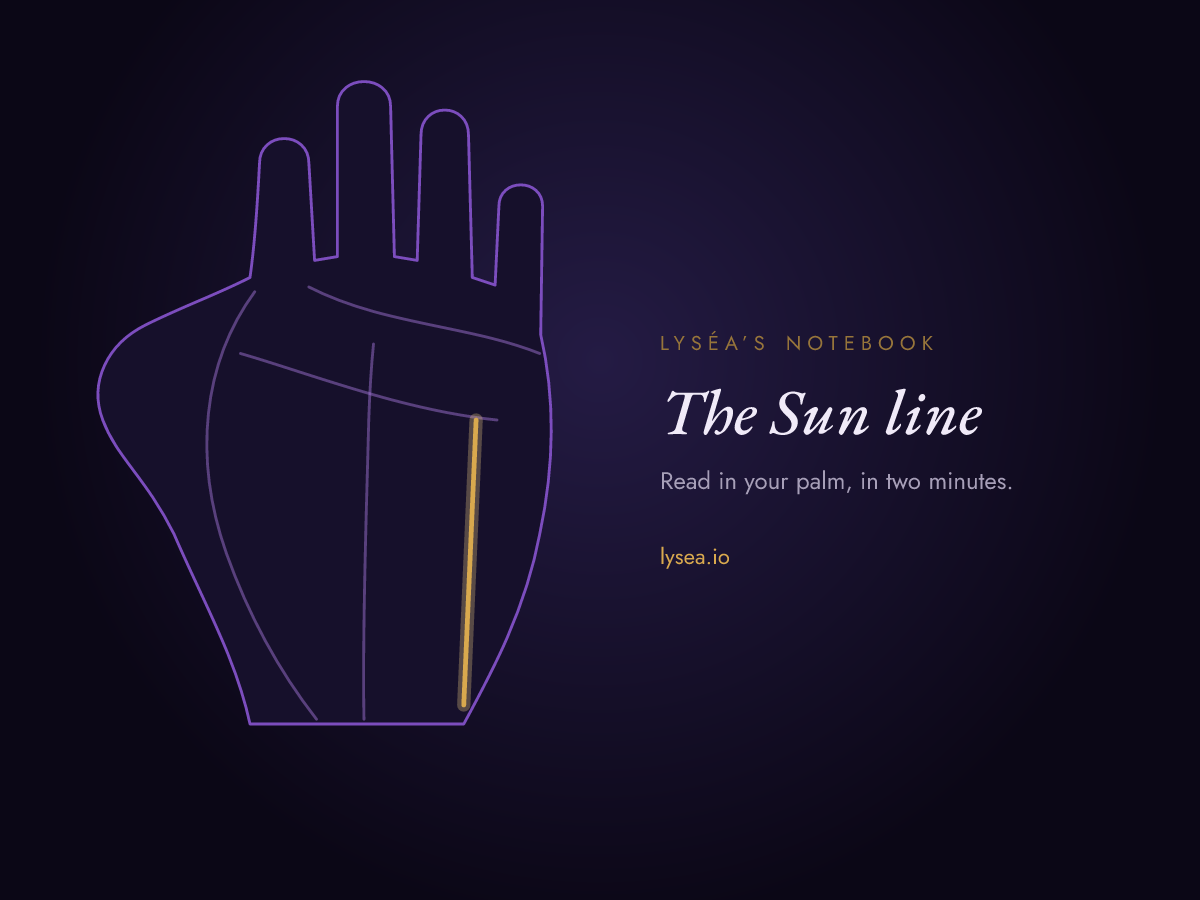
Where the Sun line is
Look below your ring finger, between the heart line and the base of the finger, then lower, towards the centre of the palm. The Sun line is a vertical, parallel to the fate line but shifted towards the ring finger. On the diagram, it is the golden vertical to the right of centre. It is frequently short — a single stroke above the heart line — and absent on many hands, which is read as well.
It is fine, finer than the major lines, and sometimes gets confused with the creases on the mount of Apollo. Lyséa tells it apart by its direction: a Sun line rises straight towards the ring finger, a crease goes anywhere.
What the tradition reads in it
The Sun line speaks of recognition: what you show of yourself, and the way it is received. A clear, long line, rising from the centre of the palm to the ring finger, belongs to someone whose work, talent or presence are seen — not necessarily famous, but recognised by the people who count. A short line, above the heart line only, speaks of a recognition that came late, or stayed within a circle.
An absent line does not mean a life without worth. The tradition reads in it a person who does things without showing them, or who has not yet found what they want to show. Many very active hands have no Sun line at all: their work speaks, they keep quiet.
A faint line, barely visible, belongs to those who have something to show and do not show it. It is the variant Lyséa mentions most often, because it is the most frequent and the most recognisable: the person knows they are capable, and waits for someone to notice without saying so.
Where it starts: the starting point
Like the fate line, the Sun line is read by its starting point. Starting from the life line, it speaks of a recognition that came from what you built yourself, often in a field close to your origins. Starting from the head line, it speaks of a recognition that came from an idea, a body of knowledge, a way of thinking that others adopted.
Starting from the heart line, short, it speaks of a recognition that came late, and often tied to an attachment — what you did for someone, or thanks to someone. Starting from the mount of the Moon, on the opposite edge of the palm, it speaks of a visibility that came from the public, from strangers, from an elsewhere: the tradition sees in it the line of artists and of those who speak in front of others.
Double, broken, starred: the variants
A double Sun line, two parallel strokes, belongs to those who are recognised on two registers — a trade and a passion, two talents that others do not connect. The tradition reads richness in it, and a possible scattering: two lights carry less far than one.
A line broken and then resumed speaks of an interrupted recognition: a change of field, a withdrawal, a period when you stopped showing yourself, before coming back differently. An island on the line speaks of a period when what you showed was badly received, or misunderstood.
A star sitting on the Sun line, or on the mount of Apollo at its tip, is one of the most discussed signs in palmistry. The tradition sees in it a recognition that goes beyond what the person expected — and Lyséa reminds you that a rare sign is rare: she reads it only when it is clear.
The Sun line and the fate line, together
The two verticals are read with each other. The fate line says the place you take; the Sun line says whether that place is seen. A clear fate line without a Sun line belongs to those who do a great deal and show little of it — and who, often, complain about it without changing anything. A clear Sun line without a fate line speaks of a visibility still looking for its direction: you are noticed before you know what for.
When both are clear and parallel, the tradition sees in it the simplest agreement between what you do and what you show of it. It is rare, and Lyséa says so when she sees it.
How Lyséa reads it on your photo
On the image of your palm, Lyséa records whether the line exists, where it starts, how far it rises, its sharpness, and its accidents. An absent line is recorded as absent and read as such. Then she writes what this line says about what you show of yourself — in the present tense, from what she recognises of your path.
This page of your notebook is one of the twelve. The photo is analysed, then deleted. Two minutes, no account, no card.
All of this is written in your palm — it still has to be read.
Scan my palm — free2 minutes. 3 free revelations, no card required.
The questions people ask Lyséa
- I have no Sun line. Does that mean I will not succeed?
- No. An absent line speaks of a person who does things without showing them, or who has not yet found what they want to show. Many very active hands have none at all.
- Are the Sun line and the Apollo line the same thing?
- Yes. The tradition gives both names to the same line, the one rising below the ring finger, because that finger is associated with the mount of Apollo.
- My Sun line is very short, just above the heart line. What does that say?
- A recognition that came late, or stayed within a close circle — often tied to an attachment, to what you did for someone or thanks to someone. It is the most frequent form.
- Is a star on the Sun line a good sign?
- The tradition sees in it a recognition that goes beyond what the person expected. But a rare sign is rare: Lyséa reads it only if it is clear, and tells it apart from a simple crossing of creases.
Read next
Updated on 2 September 2026. Palmistry is a tradition, and is cited as one. Entertainment service.