The letter M in your palm: what it means, and whether you have it

Look at your palm: if your heart, head and life lines draw an M together with the fate line, you carry the most sought-after sign in palmistry. Lyséa tells you what it is worth — and what people wrongly make it say.
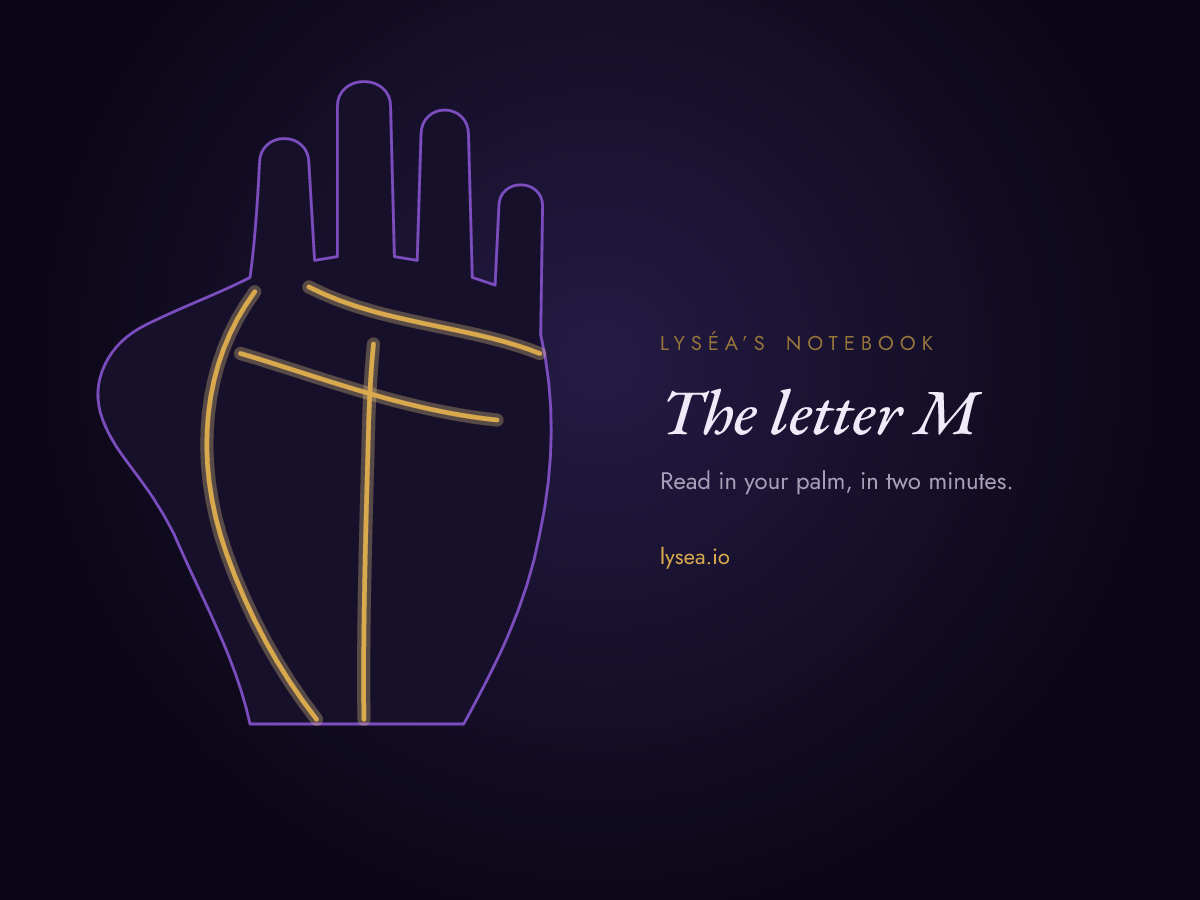
How to recognise the letter M
The M forms when four lines meet: the heart line at the top, the head line in the middle, the life line curving on the left, and the vertical fate line in the centre. On the diagram, all four are drawn in gold: followed in order, they draw the letter. The fate line has to cut clearly across the head line and reach the heart line; without it, there is only an N, or nothing.
The M is clear on roughly one hand in three — more common than people say, rarer than people see. Many look for it and find it because they want to: Lyséa counts it only if the fate line is really drawn all the way to the top. An M interrupted in the middle is not an M, it is a broken fate line, and that is read differently.
What the tradition reads in it
The tradition credits the letter M with an intuition about people that does not miss: these people sense a lie before they understand it, and nobody makes them believe for long what they do not believe. It also reads reserve in it — you know things you do not say — and a way of standing slightly apart, even where you are made welcome.
The complete M, with all four lines deep, is read as a sign of steadiness: what the person feels, what they think, what they have lived and the direction they take form a whole. They do not scatter. They can take time to decide, but they do not go back on it.
The M on both hands is rarer still. The tradition sees in it a person who was already like that on arrival and stayed that way — what life added changed nothing in the drawing. On one hand only, the M says it was built, or lost, depending on which hand carries it.
What people wrongly make it say
On social media, the M has become a sign of luck, of wealth, of a destiny apart. No tradition says that. The M speaks of a way of being — perceptive, reserved, whole — not of an assured success. Anyone who links this drawing to money or to a bright future is selling you a story.
You also often read that it is “very rare”, one in a thousand, one in a hundred thousand. That is false: a clear M is found on roughly one hand in three, and a rough M on almost all of them. Its worth does not come from its rarity; it comes from what it says when it is really there.
The four lines of the M, one by one
The heart line forms the top stroke: it says how you love, and in an M it is often long, crossing almost the whole palm. The head line forms the diagonal in the middle: it says how you decide, and in an M it is generally clear and straight. The life line forms the left leg: it says how you move forward, and in an M it often starts joined to the head line, which gives the upper point of the letter.
The fate line forms the right leg, and it is the one that makes or breaks the M. Clear and continuous, it speaks of a place taken and held. Faint or broken up, it gives a fragile M, which the tradition reads as a way of being still under construction. Lyséa reads the four separately before reading the M: the sign is only worth what makes it up.
Left hand, right hand, both
The non-dominant hand shows what you were born with; the dominant hand, what you have made of it. An M on the non-dominant hand only speaks of a steadiness you started with, which life has loosened. An M on the dominant hand only speaks of a steadiness that was built — through choices, through ordeals. On both, it is the most stable drawing a palm can show.
Lyséa reads the dominant hand first. When she is given both, she compares them, and on the letter M the comparison often says more than the sign itself.
How Lyséa reads it on your photo
On the image of your palm, Lyséa records the four lines, checks that the fate line is drawn all the way to the heart line, and counts the M only if it is clear. A doubtful M is recorded as absent: she would rather tell you it is not there than please you. Then she writes what this drawing says about you, in the present tense, from what she recognises of the way you hold steady.
The letter M is one of the rare signs your notebook records. The photo is analysed, then deleted. Two minutes, no account, no card.
All of this is written in your palm — it still has to be read.
Scan my palm — free2 minutes. 3 free revelations, no card required.
The questions people ask Lyséa
- Is the letter M in the palm really rare?
- Less than people say. A clear M is found on roughly one hand in three; a rough M on almost all of them. Its worth does not come from its rarity, but from what it says when it is really there.
- Is the M in the palm a sign of luck or wealth?
- No. No tradition says so. The M speaks of a way of being — intuition about people, reserve, steadiness — not of a success. Anyone who links it to money is selling you a story.
- I have an M on one hand only. What does that mean?
- On the non-dominant hand alone, a steadiness you started with that life has loosened; on the dominant hand alone, a steadiness built by your choices. On both, it is the most stable drawing a palm can show.
- How do I know whether my M is a real M?
- Follow your fate line: it has to cut clearly across the head line and reach the heart line. If it stops before, it is not an M, it is a broken fate line, and that is read differently.
Read next
Updated on 2 September 2026. Palmistry is a tradition, and is cited as one. Entertainment service.