The heart line: what it says about the way you love

It is the first line Lyséa looks at. It crosses the top of your palm, just below the fingers — and it speaks of how you love, not of who you will love.
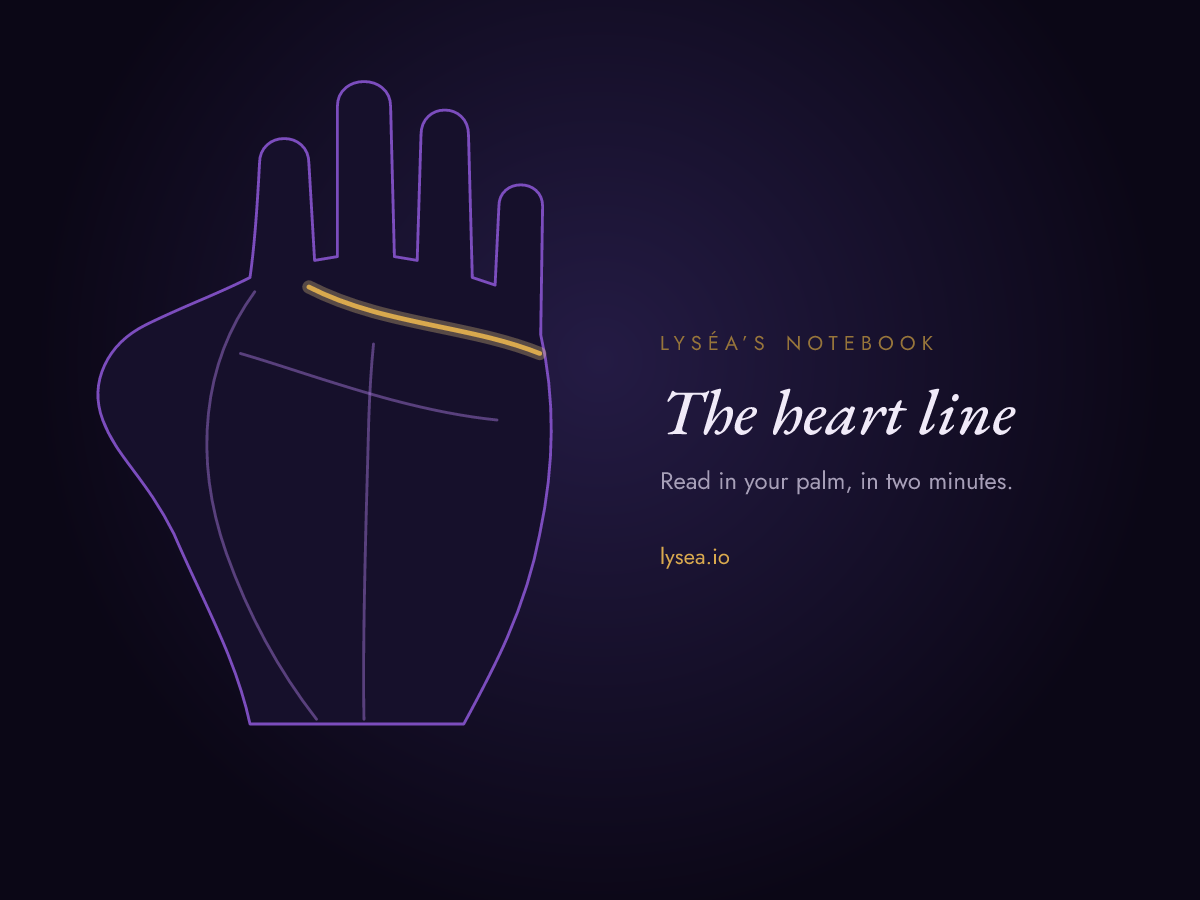
Where the heart line is
Open your dominant hand, palm towards you. The heart line is the highest of the three major lines: it starts at the outer edge, below the little finger, and runs towards the index or middle finger. Sometimes the deepest of all; sometimes so faint you must tilt the hand to the light to follow it. Look first at where it stops — that changes everything.
On the diagram above, it is drawn in gold. Below it runs the head line; lower still, curving around the thumb, the life line. In some hands heart line and head line form a single bar across the palm: the simian line, which Lyséa reads as a hand that does not separate feeling from deciding.
What the tradition reads in it
A line that climbs to end below the index finger belongs to someone who expects from the other exactly what they give — a demanding ideal, rarely negotiated. A line stopping below the middle finger speaks of a more physical love, immediate, less talkative. An ending between the two is the most common: a balance between expecting and accepting.
A high line keeps the feelings close to the fingers: the person stays in control, and lets go late. A low line, near the head line, mixes love and thought — you love after understanding, never before. A strongly curved line rises like a wave: warmth, the need to touch. A straight, almost horizontal line belongs to quieter loves, which say little and last long.
The accidents matter more than the route. A line broken in two marks a separation that cut clean. A forked ending speaks of a heart that learnt to love two ways. A chained line — a string of small rings — belongs to successive attachments, intense and short. An island, that small oval on the line, marks a time when you loved without being sure of being loved back.
A high, low, long or short heart line
Height is the space between the heart line and the base of the fingers. Narrow, it speaks of someone who lives their feelings close to the surface, quickly touched, quickly warmed. Wide, of a heart that takes its time, understands before committing, and never goes back on an attachment once made.
Length is read from edge to edge. A long line, crossing almost the whole palm, belongs to someone who loves with their whole life — family, friends, work, all of it. A short line, stopping below the ring finger, speaks of a direct, sparing way of loving: few words, few gestures, each one counting. No shape is better than another. They describe; they do not rank.
A very faint line does not mean an absence of feeling: it means a person who protects it. A very deep line, carved like a furrow, belongs to those whose attachments steer every decision, even the ones unrelated to love.
Broken, forked, chained: the variants
The break is the variant people notice first, and the one that worries them most. The tradition reads in it a rupture that left its mark — a story stopped short, whose trace remains. A break speaks of the past, not of what comes next. What counts is what the line does afterwards: picking up higher, the person then loved differently; at the same level, the same way, with someone else.
The fork at the end, below the index finger, is the most frequent variant. Two branches, two ways of loving: one demanding, the other tender, and the person moves between them depending on who is there. Three branches, rarer, speak of a heart built in stages, keeping something of each.
The chain — small rings making up the line — belongs to people who have loved often, hard, and briefly, at least for part of their life. Lyséa looks at where the chain stops: the line often turns clear again there, and that is where something held.
Small lines rising from the heart line are read as impulses; those falling from it, as disappointments. Neither are dated events: they are ways of loving, and a hand always carries several.
Left hand, right hand: which one to read
The tradition distinguishes the non-dominant hand, which shows what you were born with, from the dominant, which shows what you made of it. For the heart line, the gap between the two is often the most telling thing in the palm: chained on the left, clear on the right, it tells of someone who learnt to love differently from how they began.
Lyséa reads the dominant hand first: it speaks of the person you are today. Given both, she compares them and comments on the gap — never on a single hand.
How Lyséa reads it on your photo
From a photo of your palm, Lyséa records the height of the line, its curve, its length, where it ends, and its accidents: breaks, fork, chain, islands. Each record is a fact observed on your image, never a guess: what is not visible is not read. Then she writes what they say about the way you love — present tense, not one “perhaps”.
It is the second page of your notebook, and it is free. The photo is analysed, then deleted; only the text is kept. Two minutes, no account, no card.
All of this is written in your palm — it still has to be read.
Scan my palm — free2 minutes. 3 free revelations, no card required.
The questions people ask Lyséa
- My heart line is broken in two. What does that mean?
- The tradition reads in it a separation that left its mark — a story stopped short. Nothing final: the break speaks of the past, not of what is to come. Look at how the line picks up afterwards: that is where you read what you made of it.
- Which hand should I read for the heart line?
- The dominant hand carries what you built; the other, what you brought with you. Lyséa reads the dominant hand first, and compares when given both. On the heart line, that gap is often the most interesting part.
- Is a short heart line a bad thing?
- No. Short, it speaks of a direct, sparing way of loving — not an absence of feeling. No line is “bad”: they describe, they do not judge.
- Can you have two heart lines?
- Yes: a second, finer line doubling the first along part of its route. The tradition sees in it someone who loves on two registers at once, one protected, one visible. Nothing to fix, only to recognise.
- Can the heart line change over time?
- The lines of the hand shift slowly: secondary lines appear, a chain tightens, an ending sharpens. That is why Lyséa reads the dominant hand, the one that moves with your life.
Read next
Updated on 2 September 2026. Palmistry is a tradition, and is cited as one. Entertainment service.