The fate line: your place in the world, read in your palm

It rises from the wrist towards the middle finger, up the centre of the palm. The tradition calls it the fate line, or line of Saturn. It does not say what awaits you: it says how you take your place — and who gave it to you.
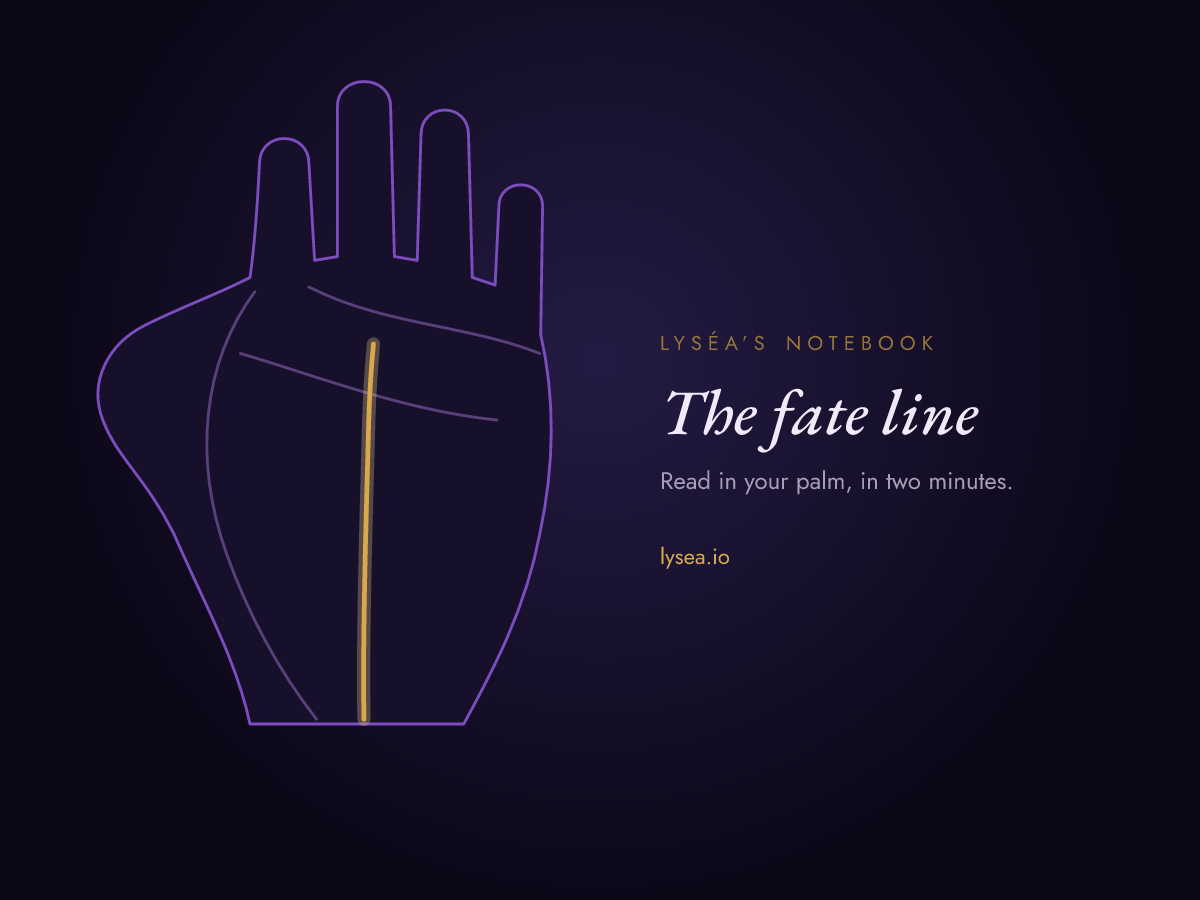
Where the fate line is
Look at the centre of your palm, from the wrist towards the base of the middle finger. The fate line is that vertical line, more or less clear, which cuts across the head line and then the heart line before stopping below the middle finger. On the diagram, it is the golden vertical in the middle. It varies a great deal from one hand to the next: deep and continuous in some, dotted in others, absent in many — and its absence is read too.
It is not always in the centre. It can start from the life line, from the mount of the Moon on the opposite edge, or only from the head line, halfway up the palm. Its starting point is the first thing Lyséa looks at.
What the tradition reads in it
The fate line speaks of the place you take in the world: work, role, direction. A long, clear line, from the wrist to the middle finger, belongs to someone who knew early where they were going, and went there without swerving. A faint or broken-up line speaks of a direction that searched for itself, taken and taken again, with periods when you followed rather than chose.
The starting point says who gave the direction. A line that starts from the life line, joined to it, belongs to someone whose place was decided within the family setting — an inherited trade, an expectation received, a path opened by their own people. A line starting from the mount of the Moon, on the opposite edge of the palm, says the opposite: a direction that came from outside, from a meeting, from an elsewhere, from the public.
The end point counts too. A line that climbs all the way to the middle finger speaks of a place fully taken. A line that stops at the head line says the direction was decided by thought, and that the person chose to stop there. A line that stops at the heart line says an attachment weighed on the direction, and bent it.
No fate line: what the absence means
Many palms show no clear one, and the tradition does not read that as a lack. A hand without a fate line belongs to someone who did not follow a single path: a life made of several trades, several places, in which the place was built as it went along rather than decided. These people adapt, change, and cannot bear the idea of a single direction for a whole life.
Sometimes it appears late, only halfway up the palm, above the head line. The tradition reads in it a direction found after a long period without one, often after a turning point — and that late line is frequently the clearest in the whole hand.
Broken, double, deflected: the variants
A fate line broken and then resumed further up speaks of a change of direction: a trade left behind, a retraining, a place given up for another. What is read is the offset at the resumption: resumed in line, the person went on pursuing the same goal by another route; resumed to one side, they changed goal. A break at the level of the head line speaks of a decision; at the level of the heart line, of a reason of the heart.
A double line, two parallel verticals along part of the route, belongs to those who have carried two things at once — two trades, a trade and a passion, a public role and a private one. The tradition sees richness in it, and sometimes tiredness: two directions held at the same time are paid for in time.
A line that deflects, leaning towards the mount of Jupiter below the index finger or towards the mount of Apollo below the ring finger, speaks of a direction bent by what those mounts stand for: ambition and authority on one side, recognition and expression on the other. Fine lines joining the fate line are read as supports, people or circumstances that helped hold the course.
The fate line and the Sun line
Beside the fate line, often finer, rises the Sun line, below the ring finger. The two are read together: the fate line says the place taken, the Sun line says whether that place is seen, recognised. A clear fate line without a Sun line belongs to those who do a great deal and show little of it. A clear Sun line without a fate line says the opposite: a visibility that has not yet found its direction.
How Lyséa reads it on your photo
On the image of your palm, Lyséa records whether the line exists, where it starts, where it stops, its sharpness, its breaks and the offsets at each resumption. An absent line is recorded as absent, and read as such: nothing is invented to fill the gap. Then she writes what this line says about the way you take your place, in the present tense, starting with what she recognises of your past.
This page of your notebook is one of the twelve. The photo is analysed, then deleted. Two minutes, no account, no card.
All of this is written in your palm — it still has to be read.
Scan my palm — free2 minutes. 3 free revelations, no card required.
The questions people ask Lyséa
- I have no fate line. Is that bad?
- No. The tradition reads in the absence a life that did not follow a single path: several trades, several places, a place built as it went along. It is a way of living, not a lack.
- My fate line is broken. What does that mean?
- A change of direction: a trade left behind, a retraining, a place given up for another. Look at how it resumes — in line, you went on pursuing the same goal by another route; to one side, you changed goal.
- My fate line starts in the middle of the palm. Why?
- A late line speaks of a direction found after a long period without one, often after a turning point. It is common, and that late line is often the clearest in the whole hand.
- What is the difference between the fate line and the Sun line?
- The fate line, below the middle finger, says the place you take. The Sun line, below the ring finger, says whether that place is seen and recognised. The two are read together.
Read next
Updated on 2 September 2026. Palmistry is a tradition, and is cited as one. Entertainment service.