The life line does not measure your life — here is what it says

Let us begin with the one thing to know: the life line does not indicate the length of a life. Lyséa says it at every reading, because it is the fear everyone brings — and it has no basis.
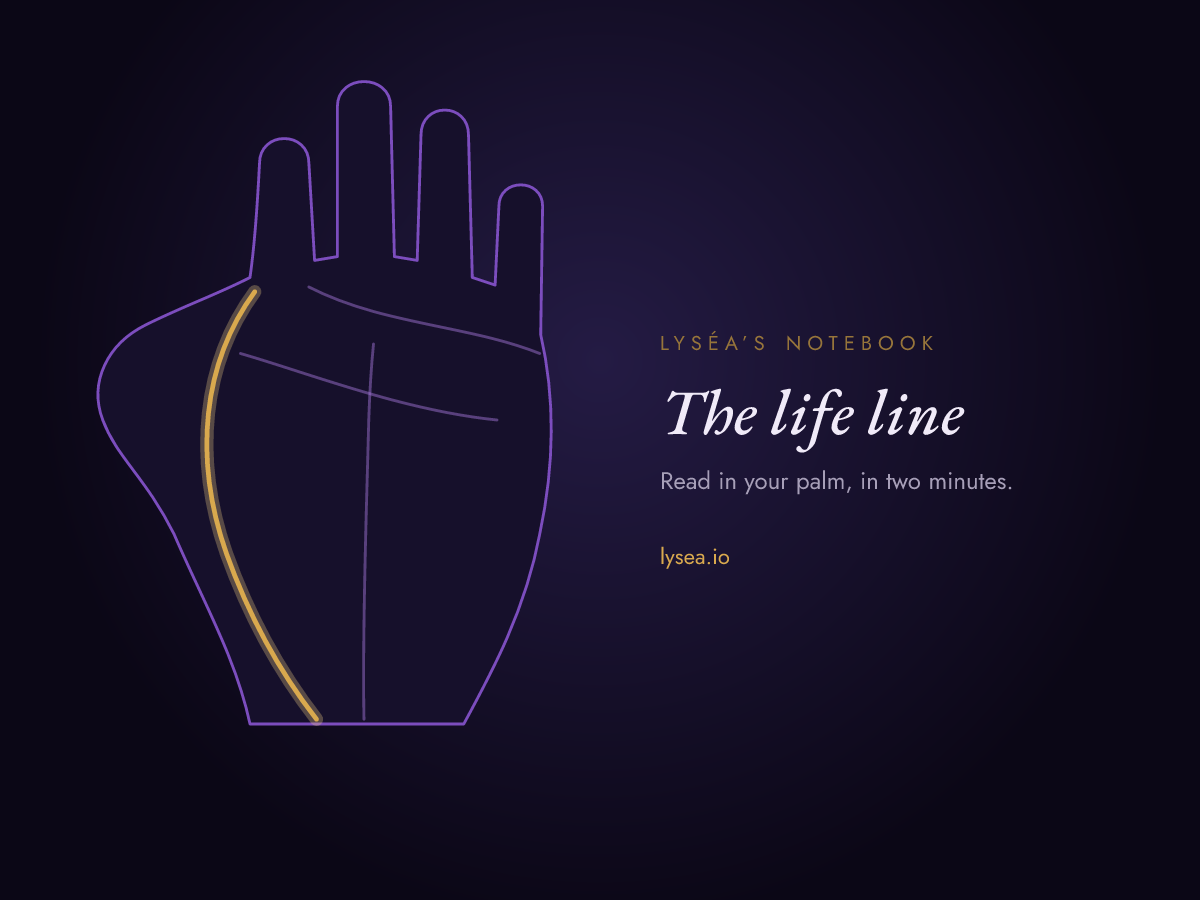
Where the life line is
It begins between the thumb and the index finger and curves down around the mount of Venus, the fleshy pad at the base of the thumb. On the diagram, it is the golden arc. Its length varies enormously from one hand to the next — and has never been linked to anything measurable. What is read is its arc and its accidents: breaks, branches, the lines that double it.
It often starts joined to the head line, then separates from it; sometimes it starts already apart, with a small gap between the two. That starting point is the first thing Lyséa looks at, even before following the arc.
Why a short life line says nothing about the length of a life
The belief is old and stubborn: long line, long life; short line, short life. No serious tradition supports it, and no observation has ever confirmed it. Palms with a very short line belong to people of great age, and the opposite is just as common. The life line speaks of the way you live, not of how long.
Lyséa says it first, before anything else, because as long as that fear is there, nothing else gets heard. Once it is set aside, the line becomes what it is: the richest in the palm on momentum, anchoring and turning points.
What the tradition reads in it: the arc
A wide arc, swinging well away from the thumb and leaving a large mount of Venus, belongs to people who go towards others, who take up room, who like movement and the world. A tight arc, staying close to the thumb, speaks of reserve — a life turned towards a small circle, chosen and kept.
A deep, clear, unbroken line speaks of constancy: the person keeps their commitments and their habits, and rarely changes course of their own accord. A faint or pale line belongs to those who adapt, who follow circumstances rather than force them. Neither is a strength or a weakness: they are two ways through.
A line that sets off early, separate from the head line from the start, belongs to someone who made their own decisions very young. A line joined to the head line for a long stretch says the opposite: a person who weighed things for a long time before acting, who needed to understand their family and their setting before breaking away.
A broken life line: the turning point, not the end
The break is what worries people most, and wrongly. A life line interrupted and then resumed speaks of a turning point: a change of place, of work, of way of living, after which you are no longer quite the same person. What counts is the resumption. If the line picks up closer to the thumb, the person drew inwards; further away, they opened up.
Very often a second line doubles the first across the break, slightly inside the arc. The tradition calls it the sister line, or line of Mars: it says the turning point was crossed with support — someone, or something within, that held while everything else moved. A broken life line with its sister line is nothing to worry about: it is even one of the most reassuring drawings a palm can show.
A clean break with no visible resumption simply means the line fades before the wrist. Again, no length of time: many people’s life line stops halfway down the palm, and their life stops at nothing.
Branches, islands and double lines
Branches rising from the life line, towards the fingers, are read as impulses: a departure, a project, an ambition taken on wholeheartedly. Those falling towards the wrist are read as periods when you gave more than you received. A branch heading for the mount of the Moon, on the opposite edge of the palm, speaks of a move, an elsewhere that counted.
An island — a small oval on the line — marks a period of scattering, when the person did several things at once without holding on to any. A chain of small islands at the start of the line belongs to eventful childhoods. A fully double life line, two parallel arcs along the whole route, is rare: the tradition sees in it a life led on two planes, often a trade and a passion, held together.
Lyséa records each of these marks from your photo and places them on the arc: the top of the line speaks of the beginning, the bottom of what is coming. A position, never an exact age.
How Lyséa reads it on your photo
On the image of your palm, Lyséa measures the width of the arc, spots the breaks and the lines that double them, counts the branches and notes their direction. Nothing is invented: an accident not visible on the photo is not read. Then she writes what this line says about the way you move forward, in the present tense, starting with what it does not say.
It is the page of your notebook she opens first after the shape of the hand. The photo is analysed, then deleted. Two minutes, no account, no card.
All of this is written in your palm — it still has to be read.
Scan my palm — free2 minutes. 3 free revelations, no card required.
The questions people ask Lyséa
- My life line is short. Will I live a shorter life?
- No. No serious tradition links the length of the life line to the length of a life, and no observation has ever confirmed it. A short line speaks of a way of living — often reserved, turned towards a chosen circle — not a deadline.
- My life line is broken. Is that serious?
- It is not serious: it is a turning point. A line interrupted and then resumed speaks of a change after which you are no longer quite the same person. Look for a small line doubling the break: that is the sister line, and it says you were supported during the crossing.
- What is the sister line, or line of Mars?
- A fine line, parallel to the life line, slightly inside the arc. The tradition reads in it a support — a person, or a resource within yourself — present through the hard periods. It is one of the most reassuring drawings in a palm.
- Why are the life lines different on my two hands?
- That is the case for almost everyone. The non-dominant hand shows what you were born with, the dominant one what you have made of it. A wider line on the right than on the left speaks of someone who opened up to the world more than their start suggested.
Read next
Updated on 2 September 2026. Palmistry is a tradition, and is cited as one. Entertainment service.