The marriage line: what the affection lines really say

They are called marriage lines, and the name is what misleads. They are affection lines: they speak of the attachments that counted, not of a contract. Lyséa reads them on the edge of your hand, below the little finger.
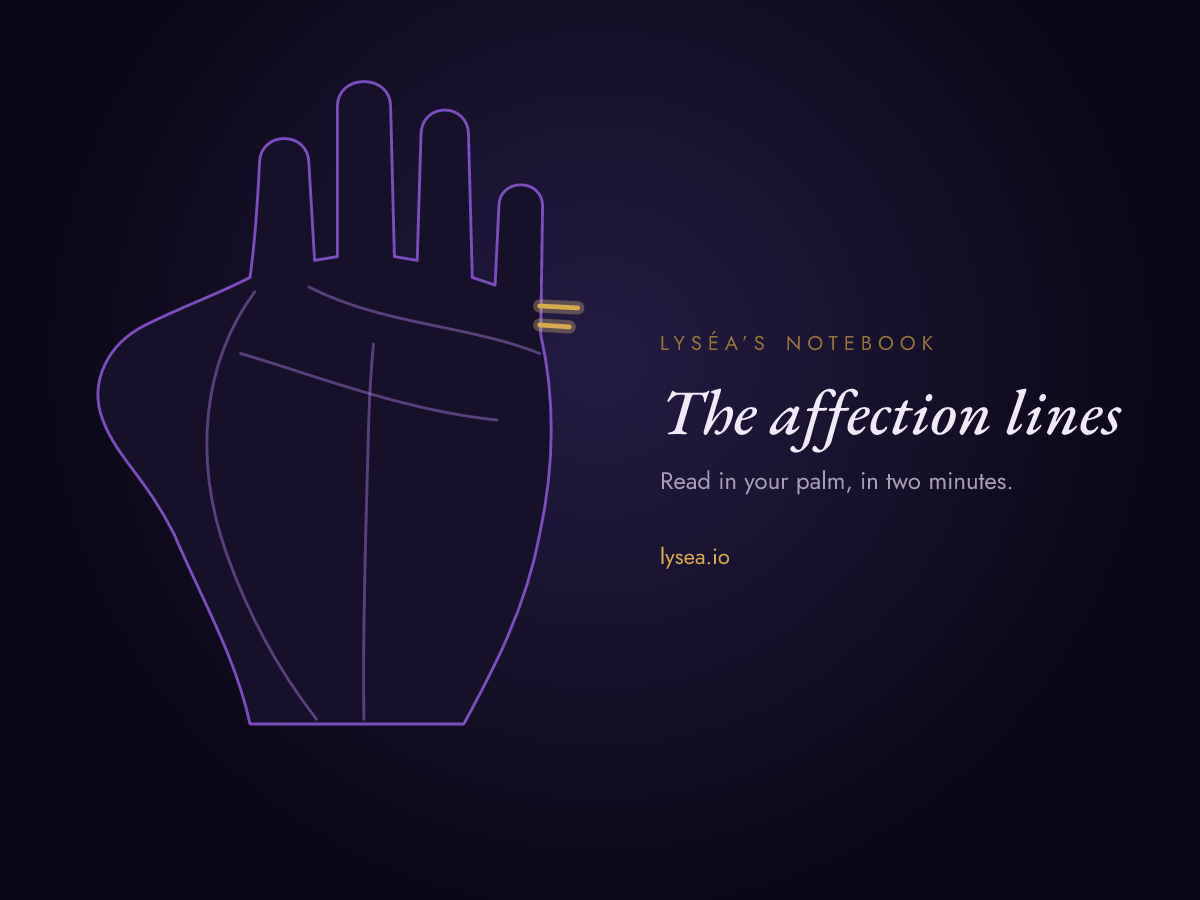
Where the marriage lines are
Close your hand slightly and look at the outer edge, between the base of the little finger and the heart line. The affection lines are those small, short horizontal strokes that enter the palm from the edge. On the diagram, they are drawn in gold, on the right below the little finger. There are often one, two or three; some hands show none clearly, and that says nothing about their capacity for attachment.
They are fine, and read better in low, raking light. Lyséa tells them apart from the creases of the skin by their sharpness: an affection line is drawn, a crease is crumpled.
How many lines, how many marriages: the misunderstanding
It is the question everyone asks, and the answer is clear: the number of lines does not count marriages. The tradition reads in it the number of deep attachments — the ones that marked the person, whether they lasted or not, whether they were lived or only carried. Someone married for thirty years can have a single line; someone else, never married, can show three.
What the number reads is a way of loving: a single clear line belongs to someone who attaches once and for a long time; several lines speak of a person who has loved several times with the same intensity, and who keeps a trace of each. Neither way is better.
Depth, length, position
The deepest line is the most telling. The tradition reads in it the attachment that counted most — not necessarily the most recent, not necessarily the longest. A deep, long line, entering far into the palm, speaks of a bond that shaped a whole life. A short, clear line speaks of a strong, brief attachment whose trace remained.
Position on the edge is read as an order, from bottom to top: the line closest to the heart line belongs to the oldest attachment, the highest to the most recent or the one to come. It is a position, never an age: Lyséa does not convert millimetres into years, and distrusts those who do.
An affection line that rises towards the little finger speaks of a bond that lifts, in which you became larger than before; a line that falls towards the heart line speaks of a bond that weighed, in which you gave a great deal. Both are often found on the same hand.
Fork, break, island: the variants
An affection line forked at its end, on the palm side, is the most discussed variant. The tradition reads in it a bond that divided: two lives that went on side by side without meeting again, a distance that settled in, sometimes a separation. Forked on the edge side, at its start, it speaks of an attachment that began in hesitation, between two people or between two lives.
A line cut cleanly in its middle marks an interruption that left a trace — a distance, a silence, something broken and then sometimes taken up again. An island on the line speaks of a troubled period inside the bond, when you doubted without leaving. A line that ends in small branches scatters: the attachment came apart more than it broke.
The very faint lines, barely visible, that accompany a main line are read as light attachments, impulses that led nowhere. They are not people: they are movements of the heart, and a hand always carries several.
The children lines, just above
On many hands, small vertical lines rise from an affection line towards the little finger. The tradition calls them children lines, and here again the name misleads: it reads in them what you wanted to pass on, to carry, to help grow — children, yes, but also projects, pupils, works. Their number counts nothing precise. Lyséa records them when they are clear, and reads them for what they are: impulses towards the future, resting on an attachment.
How Lyséa reads them on your photo
On the image of your palm, Lyséa counts the clear affection lines, records their depth, their length, their position on the edge, and their accidents: fork, break, island. A line that is not visible is not counted. Then she writes what these lines say about the way you attach yourself, in the present tense — and she always says it from what you have already lived.
This page of your notebook is one of the twelve. The photo is analysed, then deleted. Two minutes, no account, no card.
All of this is written in your palm — it still has to be read.
Scan my palm — free2 minutes. 3 free revelations, no card required.
The questions people ask Lyséa
- I have three marriage lines. Will I marry three times?
- No. The number of lines does not count marriages: the tradition reads in it the deep attachments that marked you, whether they lasted or not. Three lines speak of a person who has loved several times with the same intensity.
- I have no marriage line at all. What does that mean?
- Nothing to worry about. Some hands show no clear affection line, and their owners attach themselves like everyone else. The tradition reads in it rather a person who does not let their attachments show — not an absence of attachment.
- My marriage line is forked. Is that a separation?
- The tradition reads in the fork a bond that divided — a distance, two lives side by side, sometimes a separation. It speaks of the past or the present, never of what is to come. And a fork on the edge side says something else entirely: an attachment that began in hesitation.
- Which hand should I read the marriage lines on?
- The dominant hand, first: it carries what you have lived. On the non-dominant hand, the affection lines speak rather of what you expected before living it. The gap between the two is often the most interesting thing to read.
Read next
Updated on 2 September 2026. Palmistry is a tradition, and is cited as one. Entertainment service.